What’s launching, and when
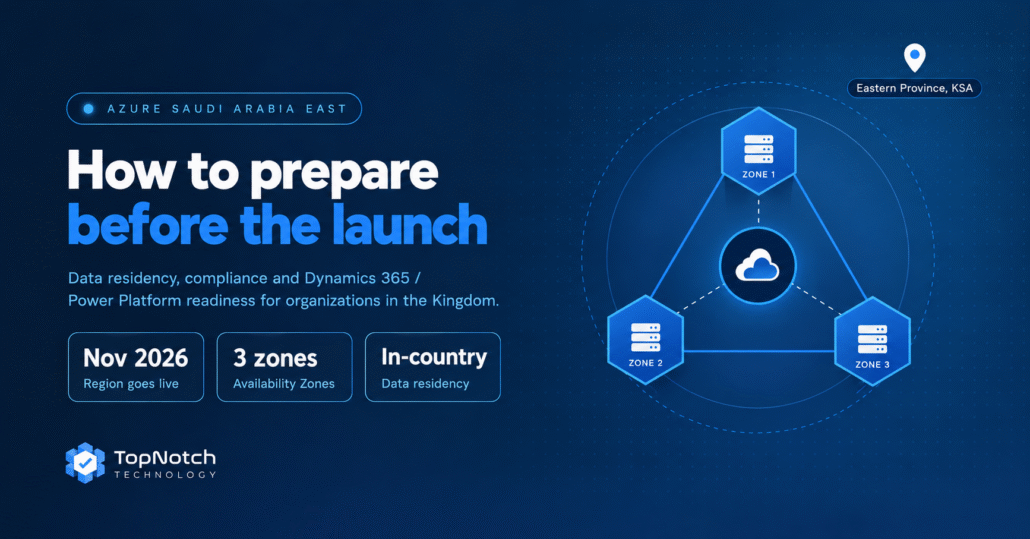
On 31 August 2026, Microsoft confirmed that its Saudi Arabia East region will be available to customers in November 2026. The essentials:
- Location: the Eastern Province.
- Design: three Azure Availability Zones, each with its own power, cooling and networking, so a failure in one zone doesn’t take your workload down.
- Scope: government and private-sector organizations can host eligible workloads and data locally and use supported Microsoft cloud and AI services from inside the Kingdom.
- Ecosystem: a Microsoft Innovation Hub in Saudi Arabia is also scheduled to open in November, alongside a new AI Arabia Center of Excellence with MCIT.
What changes for data residency and compliance
Until now, Saudi organizations using Azure have typically hosted workloads in regions outside the Kingdom, such as the UAE or Europe. That worked for many use cases, but it created friction for anyone handling personal, financial, health or government data. Teams had to justify cross-border transfers, keep certain systems on-premises, or simply avoid the cloud for their most sensitive workloads.
A local region shifts that equation:

The frameworks most organizations will map against include the Personal Data Protection Law (PDPL), the National Cybersecurity Authority (NCA) controls, including its cloud-specific requirements, and sector rules such as SAMA‘s for banking and financial services. Healthcare and government entities have their own requirements on top.
One point is easy to miss: a local region removes an infrastructure barrier, but it does not make you compliant on its own. Compliance still depends on how you design and run the environment, including where backups replicate, which services process data, who has access, and how logs and keys are managed. A workload hosted in Saudi Arabia East with backups set to replicate abroad has not solved its residency problem.
Who benefits most
The new region matters to almost every Azure customer in the Kingdom, but four groups should be planning now:
- Banks, insurers and fintechs that have kept core and customer data on-premises to satisfy regulators.
- Healthcare providers managing patient records, scheduling and clinical reporting.
- Government entities and semi-government companies with strict in-country hosting requirements.
- Enterprises scaling AI, whose Copilot, analytics and machine-learning use cases depend on large volumes of business data that they would rather not move abroad.
If your organization already runs Dynamics 365 or Power Platform for Saudi operations, you are in a fifth group: the region may give you an option to bring those environments closer to your users, but that is a planned move, not an automatic one.
What to prepare before launch
Preparation falls into three areas. Most of it can be done now, before the region is live.

1. Your workloads
Start with an inventory, not a migration plan. List every application, database and integration that touches Saudi data, then sort them into three buckets:
- Must move: workloads where regulation or contracts require in-country hosting.
- Should move: workloads where latency, user experience or resilience would clearly improve.
- Can stay: workloads with no residency constraint and no performance case for moving.
For each workload in the first two buckets, map its dependencies. A finance system that moves to Saudi Arabia East but still calls an integration service in another region may not gain much on latency or compliance. Then check service availability: confirm that every Azure service the workload uses will be offered in the new region at launch, and plan around any gaps.
2. Your compliance position
Bring your compliance, legal and IT teams together before you design anything. Agree on:
- Which data classifications must stay in the Kingdom, and which can be processed elsewhere.
- Which regulator requirements apply to you (PDPL, NCA, SAMA or sector-specific rules), and what evidence each one expects.
- Where backups, disaster-recovery copies and logs are allowed to live.
- How encryption keys are managed and who can access production data.
The output should be a short set of design rules your architects can build against. It is far cheaper to set these before migration than to retrofit them after.
3. Your Dynamics 365 and Power Platform environments
This is the area most guides skip, and where Microsoft business-application customers have the most to plan.
Dynamics 365 and Power Platform environments live in a specific geography, chosen when the environment is created. Launching an Azure region does not move existing environments automatically. Before November, find out:
- Where your current environments are hosted. Check each production, test and development environment in the Power Platform admin center.
- Whether a Saudi geography will be offered for the Dynamics 365 apps and Power Platform services you use, and from when. Business applications don’t always arrive at the same time as core Azure services.
- What a move involves. Relocating an environment to a new geography is a planned process with Microsoft, usually with a maintenance window. Factor in downtime, testing and user communication.
- What your apps connect to. Power Automate flows, custom connectors, Dataverse integrations and Power BI datasets may reach systems in other regions. Each one needs reviewing.
- Where AI features process data. Copilot and other AI capabilities have their own data-processing settings. Confirm how they behave for your environments before enabling them on regulated data.
For organizations planning new Power Platform solutions, the simplest win is often to wait for the local geography and build there from day one, rather than build elsewhere and migrate later.
Your Azure Saudi Arabia readiness checklist
Use this as a working list with your IT, compliance and business teams. Tick items off as you go.
Strategy and scope
Compliance
Technical readiness
Dynamics 365 and Power Platform
Execution
Not sure where to start? We’ll work through this list with you.
Common mistakes to avoid
- Treating launch day as migration day. The region opening in November is the start of your timeline, not the end. Teams that begin planning then will be months behind those who start now.
- Moving everything at once. Not every workload needs to be in-country. Prioritize by regulatory need and business value.
- Assuming every service is there. Build your plan around confirmed availability, not the global Azure catalog.
- Forgetting the business apps. Moving Azure infrastructure while Dynamics 365 and Power Platform environments stay abroad leaves your most-used business data exactly where it was.
- Equating location with compliance. In-country hosting is necessary for many regulated workloads, but configuration, access and governance decide whether you pass an audit.
How TopNotch can help
TopNotch Technology is a Microsoft Solutions Partner working with enterprises across Saudi Arabia and the GCC, with deep experience in Power Platform, Dynamics 365 and Azure. We help organizations get ready for Saudi Arabia East by:
- Running a cloud-readiness assessment that inventories your workloads and environments and sorts them by priority
- Mapping your compliance requirements into practical design rules
- Planning the Dynamics 365 and Power Platform side of the move, including environments, integrations and AI settings
- Designing a phased migration roadmap that keeps disruption low
The organizations that get the most from a new region are the ones that are ready when it opens. With November weeks away, now is the time to start.